Category Archives: Death!

Driven to Death by Family Troubles

Driven to Death by Family Troubles.

Mrs. Lizzie Kramer, thirty-five years old, the wife of George Kramer, a grocer, living at Mascher and Huntingdon streets [Philadelphia, PA], committed suicide yesterday at her home by taking laudanum. The woman is said to have been low-spirited for some time, caused by frequent quarrels between herself and her husband, and early yesterday morning she sent her son to a neighboring drug store and secured a bottle of laudanum. She went at once to her room, and when her mother visited her shortly after she was found lying on the bed in a semi-conscious condition, and the empty bottle was on the floor. She told her mother what she had done. Dr. Bebe was hastily summoned, but it was too late, and although everything possible was done to counteract the effect of the drug, she died soon after the doctor’s arrival. She leaves three children , the oldest being twelve years of age.

Culled from the collection of The Comtesse DeSpair
1886 Morbid Scrapbook

Shot in His Tracks

SHOT IN HIS TRACKS.

A German Burglar Fatally Wounded While Attempting to  Run Away.

During the past ten days a number of small robberies were perpetrated in the Eighth district [Philadelphia]. It was evident from the fact that the houses were all opened from the rear by the same implement, that one man or a single gang was doing the work, and the police were instructed to keep a particularly careful lookout for suspicious characters. Early on Saturday morning Policeman Ritchie saw a man in the act of scaling a fence in rear of 444 north Eighth street. He placed him under arrest, when the prisoner knocked him down and ran. The officer recovered his feet and fired after the fugitive, brining him down at the second shot.

Assistance was secured and the wounded man was taken to the station-house, where he gave the name of Frederick Glass and his residence as 910 Spring Garden street. The wound was found to be a dangerous one and he was sent to the Pennsylvania Hospital, where he died a short time after his admission.

A large chisel found in the man’s pocket was found to fit the marks on the houses which had been robbed or where attempts to force doors and shutters had been made and articles found in his room were identified as having been stolen.

Glass came to this country from Germany a short time ago and took up his lodgings at 910 Sprint Garden street with Mr. Voss. The proprietor of the house says the man had no visible means of support, and frequently remained out all night and slept during the day. The Coroner will investigate the case today.

Culled from the collection of The Comtesse DeSpair
1886 Morbid Scrapbook

A Locomotive’s Boiler Bursts

A Locomotive’s Boiler Bursts.

BALTIMORE, Md., Sept. 26.—The engine attached to the Baltimore and Ohio train from New York, due here at 8:30 to-night, burst her boiler about a mile outside the city limits. The engine was completely wrecked, and the baggage and smoking cars telescoped. Fireman Charles Lizer was scalded fatally, and Engineer Jeremiah Morningstar was badly injured. Two passengers were slightly hurt.

Culled from the collection of The Comtesse DeSpair
1886 Morbid Scrapbook

A Sunday Suicide

A SUNDAY SUICIDE.

The Result of Domestic Unhappiness—Letters Left by the Deceased—Evidence That the Suicide was Premeditated.

“Good-bye,” were the last words spoken by Frederick Fegley to his wife before killing himself in a tragic manner yesterday in the Heiner’s Springs woods about half-past eleven o’clock. The suicide was rendered unusually appalling and tragic by the fact that the man’s young wife, whom he married only a few months ago, and his own brother were compelled to witness the self-destructing deed, which is supposed to have been caused through domestic infelicity.

Fegley was married in June last to Miss Mary E. Reed, daughter of William Reed, Nineteenth and Cotton streets. The course of their courtship did not run smoothly, and after marriage domestic happiness did not fall to their lot. Miss Reed was only a little over 14 years old when they were married, and from the evidence given before the Coroner yesterday it would seem that she married unwillingly and possibly out of fear, because Fegley had threatened several times that unless she consented to be his wife he would end his life. After the marriage they lived at the home of the girl’s parents for some time, but this did not seem to be agreeable to Fegley, and he left their home and took boarding with his brother-in-law, Henry Zuber, 1824 Cotton street. Subsequently he rented two rooms in the lower section of the city, bought furniture and asked his wife to go to housekeeping with him. The mother objected to her daughter’s leaving, but told the husband that if Mr. Reed, who was in Philadelphia, would give his consent when he returned home she would yield.

Yesterday Fegley spent the morning hours in company with some friends, and about the time above mentioned went to the home of his wife for her final answer. She again told him to be patient until her father returned home. “If you don’t live with me I’ll do away with myself,” said the husband, and he walked toward the new road which leads up into Heiner’s woods.

HE SHOWS THE REVOLVER.

When about a hundred yards from the house he drew from his pocket the revolver with which he ended his life and held it up toward his wife, who was watching him from the yard where they had been talking. Believing that he intended to carry out his threat and hoping to prevent it his wife ran after him, but he started on a brisk run up the road. Henry, a brother of the suicide, who was near by and saw him run followed by his wife also feared that he had decided upon a rash act and ran after him, but neither of the two caught up to him before he reached a grassy plot under a large tree in the woods. Turning around he faced the terrified wife and brother, put the barrel of the weapon into his mouth, while the brother, who was then only a few feet away, in a frantic shout, begged him to stop. The words came too late to be heeded. As the last one fell from the lips of the excited man the shot resounded through the woods. The wound proved fatal almost instantly. The residents of that portion of the city were greatly excited, and the lead man’s mother and sister were terribly affected by the awful and unexpected news.

Coroner Denhard was sent for, and as soon as he had viewed the body it was removed to the residence of Mr. Zuber and an inquest held. Henry Zuber, Henry Fegley, brother, MRs. Fegley and Mrs. Reed were the witnesses heard, but nothing but the facts already stated were elicited, except that Mrs. Reed said she objected to her daughter going away because she was needed at home, and that both her and Fegley had promised before the marriage that she could remain with them.

Before Fegley left with his wife, after talking to her in the yard, he gave her a letter, which, as well as another found on his person and addressed to his mother, brothers, and sisters, was produced at the inquest. He charges his wife with having deceived him, but did not intend to harm her in any way and hopes to meet her in Heaven. On the back of the envelope were written the words: “To-morrow look on the porch and you will be sad forever.” After due deliberation the jury gave as the verdict, “That the deceased, Frederick Fegley, came to his death on Sunday, September 26th, from a pistol shot wound inflicted by his own hand with suicidal intent.”

That he had fully made up his mind to kill himself is certain, because in the letter to his mother he tells her not to grieve for him, that his body will be found in a few days and that he will be better off dead than living. Besides this evidence of the fact there is still a stronger one. William Y. Lyon had sent Fegley a tax notice a few days ago and on Saturday evening he came to Mr. Lyon’s house and paid it and in the conversation which followed he told Mr. Lyon that he had trouble on account of his wife and added, “Look out for some startling reports.”

The deceased was a son of the late Joseph Fegley, who was killed a few years ago in East Reading by a runaway sleighing team. He was 24 years old, a pipe cutter by occupation, and bore an excellent reputation for sobriefty and industry. Henry, George, Mrs. Henry Zuber and Mrs. Annie Gartner are the surviving brotehrs and sisters.

A watch and chain, a small sum of money and the other person effects which were taken from the pockets of the dead man were given to his wife.

Culled from the September 27, 1886 issue of the Reading Times.

A Yacht Disaster

A YACHT DISASTER.

Four Members of a Pleasure Party Go Down With the Wreck.

ST. JOHNS, N. F., Sept 24.—A disaster occurred in the Bay of St. Johns this morning, the British schooner Mary Ann, and cutting her in two. There were twenty-seven persons on board the ill-fated craft, four of whom were drowned. Their names were Charles Weeks, Nicholas Milley, Leander Milley and Sarah Ann Fahey. The others saved themselves by clinging to the main rail of the Summerset or were picked out of the water by her boats.

The Mary Ann sank within two minutes after the collision. Fahey had hold of his wife’s hand, and was drawing her out of the companionway of the sinking vessel, when the mainmast and mainsail fell, parting husband and wife forever. Gregory Leman, another passenger, was fatally injured.

Culled from the collection of The Comtesse DeSpair
1886 Morbid Scrapbook

What a Wicked City Paris Is.

What a Wicked City Paris Is.

PARIS, Sept. 27.—The city continues to furnish a singularly large number of murders and suicides. At one of the hotels yesterday the cook shot and fatally wounded his mistress and then attempted suicide, because the woman had made him jealous. A hairdresser shot and mortally hurt his mistress, because she had tired of their relationship and resolved to reform. A workman having his week’s pay in his pocket, and feeling hilarious met a pretty female organ grinder, and asked her to play him a waltz so that he might dance for her amusement while she played for his. The woman’s male companion instantly became incensed at the request of the happy-minded workman, and shot him dead

Culled from the collection of The Comtesse DeSpair
1886 Morbid Scrapbook

His Third Attempt at Suicide

His Third Attempt at Suicide.

ITHACA, N. Y., Sept. 27.—Peter Sausman, formerly a wealthy man and the owner of one of the best farms in this country, cut his throat in a bath-room here yesterday. He is still alive, but cannot recover. This was the third attempt at suicide he had made within a week. His action was caused by melancholia, resulting from losses and poverty.

Culled from the collection of The Comtesse DeSpair
1886 Morbid Scrapbook

Burned to Death.

On Friday of last week Mr. Daniel Dunn, an old man about 75 years old, living with Garret Joyce of Washington Lake [Minnesota], went into the field to burn some brush and while so doing his clothes caught fire, and although assisted by the daughter of Mr. Joyce, before the fire could be extinguished he was so badly burned that he died in a few minutes after being helped to the house. On arriving at the house he asked for bread and coffee, but before he had tasted them death intervened.  [April, 1878]

Culled from Coffee Made Her Insane

An Empty Morphine Bottle Was Near.

CHICAGO, Sept. 27.—Attorney Lawrence J. J. Nissen was found lying dead in his office at 170 East Madison street yesterday morning. Upon a table near by stood an empty morphine bottle. At his late home, 107 Schiller street, whither the body was at once conveyed, the theory of suicide is discredited, and the confidence expressed that he died of paralysis. The deceased was for forty years a resident of Chicago, and was formerly a partner of Judge Barnum in the law business. He was fifty-nine years of age and leaves a wife and several grown children.

Culled from the collection of The Comtesse DeSpair
1886 Morbid Scrapbook

So I was going to put this in the “Suicide” category, but then I did additional research and found this article that made me change it to the “Accidental Death” category:

They Sought Relief from Insomnia.

An inquest was held yesterday at No. 432 West Twelfth street on the body of the lawyer, Lawrence J. J. Nissen, who was found dead in his office, No. 170 East Madison street, Sunday morning. A partly emptied bottle labeled morphine was found on a table by the side of the dead man. From the testimony of the daughter, Miss Emma Nissen, a teacher of elocution, it was learned that the lawyer had for years past suffered from insomnia, and that he was always in the habit of taking the drug to induce sleep. Some five years ago he had a narrow escape from death by taking an overdose. Judge Barnum, a former law partner of deceased, also stated that Mr. Nissen was long a sufferer from sleeplessness. The verdict was in accordance with the facts.

Culled from the September 28, 1886 issue of the Chicago Tribune.

The Trial of Madame Hugues

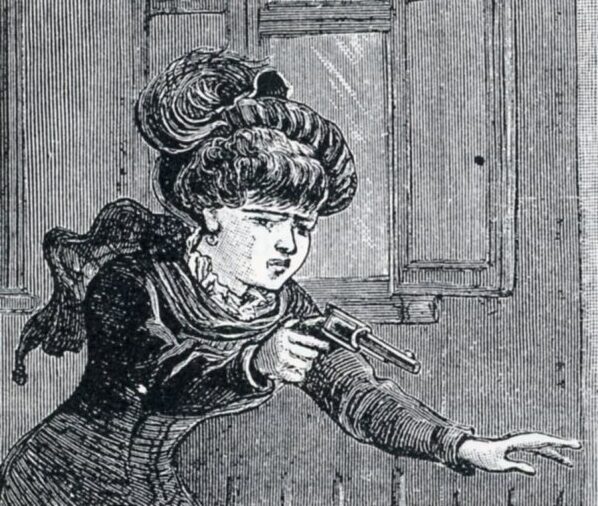
The trial of Madame Clovis Hugues for the murder of a man named Morin, took place yesterday, and resulted in a verdict of “Not guilty.” The case from beginning to end displayed all the elements of a sensational romance. Morin was what, in England, would be termed a “private enquiry officer,” and it was not disputed that he manufactured evidence that mounted to a gross calumny upon the honour of Madame Hugues. This lady appears to have been a somewhat distinguished personage, for her husband had already fought with and killed a man who had previously aspersed her character. Upon this occasion Madame Hugues determined to avenge her own honour. She awaited a favourable opportunity and then shot Morin “like a dog.”  He lingered for some weeks in fearful agony and then died. Madame Hugues admitted, candidly, that the deed was premeditated, and when under examination she did not hesitate to justify her crime as a well-deserved punishment. The trial of such a woman was naturally a scene of considerable excitement. The circumstances of the crime were recounted by eye witnesses, and there was abundant testimony of the abominable persecution to which Madame Hugues had been subjected, and of the purity of her maiden life. M. Gatineau, her counsel, very skillfully availed himself of the favourable points of his client’s case. With consummate art he described her uneventful life as an unmarried girl, her marriage, essentially one of inclination, and then the blight caused by an unworthy imputation of pre-nuptial unchastity. The jury, after a very short deliberation, acquitted Madame Hugues on both charges of murder and premeditation, but they condemned her to pay two thousand francs by way of indemnity to the father of the victim. It is impossible to conceive that such a result could have been brought about in England. Although we hold equally high notions of honour, an English Jury could scarcely be induced to justify a premeditated murder simply upon the grounds of such provocation. The contrast between the offence for which the Captain and mate of the Mignonette are now serving six months’ imprisonment, and that for which Madame Hugues has to pay the nominal penalty of two thousand francs, is by no means in favour of the latter.

Culled from the January 9, 1885 issue of the Gloucester Echo.