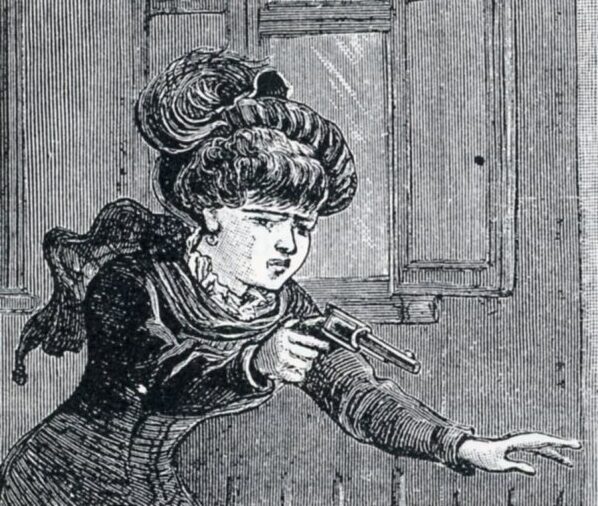
PARIS, Sept. 27.—The city continues to furnish a singularly large number of murders and suicides. At one of the hotels yesterday the cook shot and fatally wounded his mistress and then attempted suicide, because the woman had made him jealous. A hairdresser shot and mortally hurt his mistress, because she had tired of their relationship and resolved to reform. A workman having his week’s pay in his pocket, and feeling hilarious met a pretty female organ grinder, and asked her to play him a waltz so that he might dance for her amusement while she played for his. The woman’s male companion instantly became incensed at the request of the happy-minded workman, and shot him dead
Culled from the collection of The Comtesse DeSpair
1886 Morbid Scrapbook
The trial of Madame Clovis Hugues for the murder of a man named Morin, took place yesterday, and resulted in a verdict of “Not guilty.” The case from beginning to end displayed all the elements of a sensational romance. Morin was what, in England, would be termed a “private enquiry officer,” and it was not disputed that he manufactured evidence that mounted to a gross calumny upon the honour of Madame Hugues. This lady appears to have been a somewhat distinguished personage, for her husband had already fought with and killed a man who had previously aspersed her character. Upon this occasion Madame Hugues determined to avenge her own honour. She awaited a favourable opportunity and then shot Morin “like a dog.” He lingered for some weeks in fearful agony and then died. Madame Hugues admitted, candidly, that the deed was premeditated, and when under examination she did not hesitate to justify her crime as a well-deserved punishment. The trial of such a woman was naturally a scene of considerable excitement. The circumstances of the crime were recounted by eye witnesses, and there was abundant testimony of the abominable persecution to which Madame Hugues had been subjected, and of the purity of her maiden life. M. Gatineau, her counsel, very skillfully availed himself of the favourable points of his client’s case. With consummate art he described her uneventful life as an unmarried girl, her marriage, essentially one of inclination, and then the blight caused by an unworthy imputation of pre-nuptial unchastity. The jury, after a very short deliberation, acquitted Madame Hugues on both charges of murder and premeditation, but they condemned her to pay two thousand francs by way of indemnity to the father of the victim. It is impossible to conceive that such a result could have been brought about in England. Although we hold equally high notions of honour, an English Jury could scarcely be induced to justify a premeditated murder simply upon the grounds of such provocation. The contrast between the offence for which the Captain and mate of the Mignonette are now serving six months’ imprisonment, and that for which Madame Hugues has to pay the nominal penalty of two thousand francs, is by no means in favour of the latter.
Culled from the January 9, 1885 issue of the Gloucester Echo.
How Young Charles Archibald Got Out of a Very Serious Affair.
Charles Archibald, a young weaver, yesterday pleaded guilty before Judge Peirce [sic] to manslaughter in causing the death of John Cameron on the 15th of May, and Robert Hamilton, indicted for complicity in the offence, was acquitted. It was in evidence that Archibald and Cameron, while in an intoxicated condition, engaged in a sparring bout for fun on a hill near Hartwell street and Indiana avenue, and that Hamilton, who had been drinking with them, was a witness to the encounter. The contestants, it was said, were so drunk “that they fell all over each other,” and in the last round Cameron received an injury in the head which caused death a few hours later. District Attorney Graham said that it was but fair to say that Archibald was a hard-working young man, who had borne a previous good character, and that in view of all the circumstances of the case he would recommend him to his Honor’s clemency.
“Sparring in fun in this case proved to death in earnest,” said Judge Peirce to the prisoner. “I am sure you regret it. The root of the whole matter lies in the drinking custom of this city. It is a pity that you and other hard-working young men like you should spend all your wages for that which is not bread or strength, but which leads to so much misery. I have taken into consideration your previous good character and the recommendation of the District Attorney, and the sentence of the Court is, that you undergo an imprisonment of four months and two weeks, from the 14th day of May last.” This had the effect of discharging the prisoner yesterday.
Culled from the collection of The Comtesse DeSpair – 1886 Morbid Scrapbook
Tramps Enact a Farm House Horror on an Unprotected Woman.
FARMINGTON, Mo., Sept. 30.—[Special.]—A brutal and horrible murder of a young woman named Annie Veath, daughter of a respectable old German named Peter Veath, was committed in St. Genevieve county, about sixteen miles from this place yesterday. While the mother of the young woman was absent at a neighbor’s and the boys were at work in the fields, some villainous tramp went to the house, murdered her and threw her body into the well, where it was found by the family. Some of the furniture drawers were opened, as if robbery was the object of the murder, but whether the girl was abused before being killed is not known. Sheriff Jokerts of St. Genevieve county passed through here this morning on the hunt of the villain, having secured the measure of the man’s track at the house. He tracked the fellow some distance in this direction. A man with a dark moustache and dressed in dark clothes had been at the house during the day before the murder was committed. He wanted to know if he could get luncheon for himself and a partner, saying he would return in a short time. The young woman’s brother was at the house after this visit, and was told of the man being there, but paid no further attention to it and went to work again.
Great excitement prevails in the vicinity, and if the guilty party were caught there would likely be a neck-tie party. A reward of $200 has been offered for the apprehension of the murderer.
Culled from the collection of The Comtesse DeSpair – 1886 Morbid Scrapbook
I researched the newspapers but I couldn’t find any evidence that the tramp was ever abducted. If indeed a tramp was the one responsible for the murder and not the father or brother or another “respectable” man. One never knows, does one?
The Brutality of a New York Policeman, Who Kills an Old Man.
The Crimes a Southern Woman Is Charged with by a Negro Murderer.
RALEIGH, N.C., Sept. 29—Last Thursday night the store of A.D. Owens, at Creswall, Martin county, was entered by burglars. Owens’ dwelling adjoined the store. He heard a noise and stepped to the door. As he did so he saw two burglars, one of whom raised a gun and fired. Forty buckshot entered the stomach of Owens, who in a few minutes was corpse. Since that time the authorities have been on the track of the burglars and murderers. Monday night Sheriff Sprewill arrived at Plymouth with the wife of the murdered man and two negroes. Another negro, James Davenport, alias James Ambrose, was shot and killed.
One of the negroes confessed some days ago that Mrs. Owens had hired them to kill her husband. She wished them to drown him, and prepared water in a barrel for that purpose. She gave him medicine to put him in a sound sleep, and the three negroes actually stood by his bedside ready to commit the crime. Their courage failed them. Finally Ambrose some nights afterward entered the store, and when Owens appeared shot him. Ambrose was pursued, and on making a desperate attempt to kill the members of the Sheriff’s posse was shot through the heart. Miss Owens and the other two negroes are now in jail at Plymouth to await trial.
Culled from the Thursday, September 30, 1886 issue of the Carlisle Weekly Herald (PA).
*************************
And I’m sure you want to know what happened to dear Mrs. Owens? Here’s a follow-up from the January 31, 1887 issue of The Times Herald:
TERRIBLE STORY OF CRIME.
CLOSE OF THE OWENS MURDER TRIAL AT WASHINGTON, N.C.
The Death Sentence Passed Upon One of the Culprits and the Other Two Sentenced for Life—How Owens Was Murdered—A Depraved Woman’s Murderous Design.
WASHINGTON, N.C., Jan. 31—The Owens murder trial, which abounded in startling revelations, has resulted in the sending of Mrs. Owens and Rev. Isaac Jones to the penitentiary for life and a death sentence against Stark Simpson. Simpson has taken an appeal to the supreme court.
The history of the terrible affair is as follows: A.D. Owens, a white man, was a merchant at Cresswell, Washington county. His wife was a woman with whom in early life he had contracted a liaison, and whom he married later, in defiance of the ridicule of friends and the entreaties of his relatives. He was, therefore, cast off, and though a man of respectable family was cut off from all social intercourse. Mrs. Owens had several children born before wedlock, and one of them, a daughter 20 years of age, was suspected of intimacy with a negro named James Ambrose. The latter was a desperado and outlaw, and was the man who some time since set fire to the jail at Harrell, while a prisoner therein, and so made his escape. Owens, angry at the girl’s love for Ambrose, locked her up. Her mother took her part, not objecting to her intimacy with Ambrose. This led to a quarrel, and finally to Owens’ death. The quarrel occurred last September, and Mrs. Owens, her daughter and Ambrose at once began to plan to kill Owens.
They admitted to their confidence Isaac Jones and Stark Simpson. All agreed that the wife should poison her husband. She gave him poison, but in too great quantities, and he was only made sick. The failure of the plan enraged Mrs. Owens. She conferred again with Jones, who was looked up to by all the conspirators. Jones advised her to give her husband an opiate, and said that when he was under its influence at night she should give him the signal. They would enter the house, take Owens from the bed, and drown him in a barrel of hot water. Mrs. Owens heated the water and administered the opiate. She gave the signal and her negro allies entered. Owens was partially stupefied, and all the party stood by his bedside. Jones declared that it was unsafe to make the attempt to end his life in that way. Mrs. Owens, furious at the repeated failures, urged them to shoot him. Jones concurred in her idea, and said that as enough were present to do the deed he would go to his church. It was agreed that the negroes should return later in the night and make a noise as if breaking into Owens’ store, which adjoined the house. The plan was carried out. Mrs. Owens roused her husband, telling him burglars were attempting to enter. Owens declined to go out. She urged him to do so. Finally he went into the yard, and clapped his hands together to frighten the burglars. In an instant the report of a gun was heard, and Owens fell, pierced by many buckshot. In half an hour he died. The community was soon in a state of the wildest excitement, and Ambrose was at once suspected. Two men, Bosnight and Spruill, volunteered to capture him. Entering his cabin, they found him. He cried out:
“If you want me for shooting at Owens, you are after the wrong man.”
With these words he sprang at Spruill, threw him to the floor, and, drawing a revolver, attempted to shoot him.
Bosnight seized his revolver, but Ambrose drawing another again attempted to shoot Spruill. Bosnight then fired at him, blowing off the top of his skull. Concealed in Ambrose’s house was Stark Simpson, who was arrested. He confessed the deed, and revealed the awful crime above stated. He said that Ambrose Shot Owens, and also that Mrs. Owens had promised each of them $20 and a pair of shoes for killing her husband.
To verify Simpsons’ statement they took him to Mrs. Owens’ door. She came out when Simpson called, and Bosnight and Spruill, who were concealed, heard her acknowledge her obligation for killing Owens. She told Simpson to call in the morning and get his money. The men entered and arrested her. The people were furious, and came near lynching her and her two accomplices, but they were safely jailed. Later they moved the case from Washington to Beaufort county. Upon the witness-stand Simpson testified in his own behalf, and retold all the horrible story, and his statement caused a profound sensation.
The Brutality of a New York Policeman, Who Kills an Old Man.
NEW YORK, Oct. 8.—Max Aronson, fifty years old, a Hester-street grocer, was brutally clubbed by Policeman Wood, of this city, in his store on Wednesday last and died to-day. A Coroner was summoned to take his ante mortem statement, but found the old man unconscious and dying. According to the statement of a son and the physician, the clubbing was one of the worst cases of police brutality reported for years. They say that a boy tried to steal some fruit, but was ordered away by the old grocer. The boy’s mother interfered and created a row. Policeman Wood took the woman’s part, and accused Aronson of striking her, following his words by clubbing him. The skull was fractured. Two sons interfered, and driving the officer away, called a physician.
While the physician was caring for the old man, Policeman Woods returned with another officer, and brutally clubbed the old man again. The two were driven out, but returned and took the old man away from the physician, and locked him up with the whole family for forty-five hours. The old man was not allowed medical attendance. After their release on bail Max Aronson began to sink, and died to-day. The policeman is under arrest.
Culled from the collection of The Comtesse DeSpair – 1886 Morbid Scrapbook
Incidentally, I tried to find out whether the killer cop was ever punished for his crime, but I could not. I highly doubt it.
HARTFORD, Conn., Oct. 4.—Henry Hotchkiss, a musician, aged thirty-five, has for some time been in trouble with his wife, from whom he is supposed to have separated. They had two children. Yesterday afternoon at two o’clock they met on Market street. He drew a revolver and fired two shots at her, one of which took effect in her head and the other in her back. She died in a few minutes. Hotchkiss then fired one shot into his own head, but the wound inflected is thought to be but slight. He was taken to the hospital. The tragedy has caused great excitement.
Culled from the collection of The Comtesse DeSpair – 1886 Morbid Scrapbook
Follow-up: Mr. Hotchkiss did, indeed, survive (from the March 4, 1887 issue of The Meriden Journal):
STATE PRISON FOR LIFE.
The Sentence of Henry S. Hotchkiss for Murdering His Wife in Hartford.
At 4:30 yesterday afternoon Henry S. Hotchkiss was brought before Judge Torrance in the Hartford Superior Court room. S. F. Jones, counsel for Hotchkiss, repeated the story of the shooting of his wife Etta, by the prisoner, and made the plea that Hotchkiss was insane at the time of the shooting. He claimed that insanity was caused by the unfaithfulness of the prisoner’s wife. He was ready to plead guilty of murder in the second degree. Judge Briscoe of counsel for the prisoner made a similar plea. State Attorney Hamersley said that it was questionable in his mind whether the jury would convict of murder in the first degree, but it would have no doubt of a verdict of murder in the second degree. As far as he was concerned he would accept the plea and leave it wholly with the court to decide as to the acceptance. The court agreed to accept the plea and Hotchkiss was put to the plea and pleaded guilty to murder in the second degree. Judge Torrance then pronounced sentence that he be confined to the Connecticut state prison during his natural life.
The crime for which Henry Hotchkiss is consigned to a living death was the murder of his wife, Etta Hotchkiss, on October 4, 1886. On that day, while Mrs. Hotchkiss was walking on Market street in company with another woman, she was accosted by her husband, but refused to speak to him. Then the man pulled a small revolver from his pocket and fired two shots directly at the woman’s back. Both bullets struck her and she staggered into a store, fell to the floor and died instantly. As soon as Hotchkiss saw the result of his desperate work, he shot himself in the head, but only inflected a flesh wound. The cause of the murder was jealousy, aggravated by Mrs. Hotchkiss’ alleged improper behavior. Hotchkiss has two children, who at present are with friends at New Britain.
Culled from the Thursday, August 6, 1896 issue of The World newspaper (New York, New York).
SLAIN BY HER SISTER.
The Girl Was Mad and Chopped Her Head to Pieces While She Slept.
HACKED UNTIL SHE WAS TIRED.
Then Washed Her Hands, Slipped from a Window and Told the Police How She Did It.
ALICE HEANEY WAS HARMLESSLY INSANE.
Kate Larkin, Her Sister, Had Been a Mother to Her for Years–Now She Is Dying in a Hospital.
For several years poor Alice Heaney has been regarded as “harmlessly insane.” Yet at 3 o’clock yesterday morning, lighted only by the moonbeams which streamed in through the open windows of the little home at No. 123 Classon avenue, Brooklyn, she attacked her sleeping sister with an axe, and hacked the defenseless head into an almost unrecognizable mass.
The victim is Mrs. Kate Larkin, a hard-working, self-supporting widow who for years had surrounded the demented girl – her sole blood relative – with devotional care and a mother’s love. A spark of life still lingered in the terribly mutilated body after the mad sister had thrown away her weapon through sheer weariness, but the physicians pronounce Mrs. Larkin’s case as hopeless.
Sergt. White was nodding half asleep at his desk in the De Kalb Avenue Police Station at 3:30 A. M. when a small, pale-faced woman slipped quietly in from the street. The early visitor was well but plainly dressed in a muslin skirt and fresh shirt waist. At first glance there was nothing unusual in her appearance.
“I wish to give myself up,” said the woman quietly, very much as another would have said, “Good morning.”
“You do, hey?” queried the sleepy sergeant, thinking that his visitor was about to ask for a night’s lodging. But the girls’ answer awoke the officer like an electric shock.
Told of the Murder
“You see, sir,” she said, in that even, unemotional tone. “I have just killed my elder sister with an axe. You will find her dead at home at No. 123 Classon avenue.”
“Do you know what you are saying, Miss?” demanded the astonished policeman.
“Yes, indeed,” replied the visitor, smiling at the bluecoat’s surprise. “I killed her because I feared her. She was cross to me yesterday and threatened to cut my throat. Before I went to bed last night I prayed for her – oh, how earnestly! We sleep together, you know, and at 3 o’clock this morning I awoke to find the moonlight pouring over the bed. It was bright and beautiful. I grasped at the moonbeams. She stirred and muttered in her sleep.”
The light of madness came into the shifting eyes of the queer little creature as she leaned far over the sergeant’s desk and whispered the balance of her terrible story.
“Yes, she stirred,” continued the woman, “and I made up my mind that she should die. So I just slipped out of bed and stole barefooted into the yard. There I found the axe. It was a great big one, with a blade as keen as a razor. Going softly in to our sleeping room, right up tot he bedside, I stood over my sister. The moonlight was full upon her and showed me where to strike. She shrieked at the first blow, but I cut her down again and again. She had to die. I did not dare to let her live.”
The Sergeant Shuddered.
Sergt. White is a well-seasoned officer, but the mad woman’s story, as he afterwards confessed, brought out the cold perspiration.
Detaining his visitor he telephoned the facts to the Clermont Avenue Station in which precinct is the Classon avenue house.
Sergt. O’Connell sent Policemen Gallagher and Lynch to investigate. They found the little two-story frame house tightly closed, its inmates seemingly fast asleep.
It required a dozen tugs at the doorbell to get a response from Mrs. Mary Bodie, the aged owner of the little cottage, who sleeps on the top floor. She nearly swooned in terror when the policeman bluntly explained the object of their visit.
“It must be a mistake,” she gasped. “Mrs. Larkin and her young sister Alice occupy my basement. The girl is silly, but harmless, and the widow is more than a mother to her.”
Reluctantly the old lady piloted the policeman down the narrow stairs to the basement. As the aged woman and the two men stood in the lower hall groping in the darkness for the door of Mrs. Larkin’s room, they caught a faint sound, as of dripping water.
Gallagher entered the front room used by the sisters as a sleeping apartment and stopped short just within the threshold. The sight that brought him to a standstill would have staggered most men, had their nerves been ever so strong.
On the bed, in the full light of the moon, lay Mrs. Larkin. Blood ran from a score of terrible wounds on head and face, and dripped from the saturated bedding to the uncarpeted floor. The patter of the red drops was the sound that had caught the attention of the policemen as they stood in the outer hall.
The axe with which the butchery had been done lay on the floor close by the bed, its heavy blade clotted thick with blood. Mrs. Larkin had evidently made no struggle for her life – the first crushing blow had rendered her unconscious.
Her mad assailant, satisfied that her victim was dead, had deliberately washed the blood stains from her hands and, after dressing with considerable care, had left the house by a rear window connecting with an alley and the street. She had then walked straight to the De Kalb Avenue Station, three blocks away, and made her startling confession to the sleepy sergeant.
Mrs. Larkin still lived when the police found her, but the pulse of life was beating faintly. Policeman Gallagher sent in a hurry call that brought an ambulance in hot haste from the Homeopathic Hospital.
The unconscious sufferer was taken to that institution, where House Surgeon W. W. Blackman found three separate and distinct fractures of the skull, each of itself almost inevitably fatal. One terrible stroke of the axe had cut out the woman’s right eye and smashed the bridge of her nose. Fifteen other blows had each left a deep scalp wound covering the head with a net work of mutilations.
Identified Her Sister.
Mrs. Larkin partially regained consciousness an hour after reaching the hospital, and managed to identify the mad sister as her assailant. Then she sank into semi-consciousness and throughout the day lay writhing in convulsions, which grew steadily weaker as her life ebbed away. The physicians do not regard her recovery as possible.
Alice Heaney was taken before Justice Teale late in the day and committed, to await the result of her sister’s injuries. She was perfectly cool and self-possessed, and retold her gruesome story with few additions.
“I killed her,” she said, “because she had beaten me and had threatened to cut my throat.”
The prisoner showed no sign of regret for her mad act until she was led from the court Raymond Street Jail. Then, turning to a court officer she whispered, in a frightened way:
“I meant to murder her, you know, but I’m sorry now that I did it.”
Mrs. Larkin was the wife of Perry Larkin, an old-time professional ball player who drank hard and embittered her life. She was finally forced to leave him and make a home for herself and sister Alice. Two years ago she took possession of the little basement in Classon avenue, and began her single-handed struggle for bread.
Alice Had Religious Mania.
Alice, now twenty-two years old, has from early childhood been known as queer. Once she was seized with religious mania and kept the neighbors so alarmed with her ravings and prayers that it became necessary to remove her to the Flatbush Asylum, but several months ago she was returned to her sister’s care as “harmless.”
Mrs. Larkin earned her living as a washerwoman, and won the respect and friendship of her neighbors by her indomitable energy and never-failing cheerfulness.
During the day preceding the tragedy Mrs. Larkin worked hard over her tubs, while the demented sister moved quietly about the little home, giving no sign of approaching madness. The sisters chatted pleasantly with neighbors until 9 P.M., and then retired, seemingly in perfect accord.
Alice, in her cell at Raymond Street Jail, passed a quiet day, but at nightfall a returning fit of madness seized her. Physicians were summoned from the Brooklyn Hospital, but they could do little for the frenzied woman. At a late hour preparations were being made for her removal to a padded cell.
Follow-Up from the August 13, 1896 issue of The Standard Union (Brooklyn).
SHE IS A LUNATIC.
Dr. King Examines Alice Heaney as to Her Sanity.
FINDS SHE IS CERTAINLY MAD.
THE GIRL MURDERESS WILL PROBABLY GO TO THE ASYLUM FOR INSANE CRIMINALS AT MATTEAWAN– MR. BACKUS APPOINTS LAWYER “BOB” ELDER TO LOOK AFTER HER INTERESTS.
An inquiry was held in the office of District Attorney Backus this morning by Dr. James S. King, of 146 McDonough street, who was yesterday appointed a commission to determine the mental condition of Alice Heaney, who on Aug. 5 assaulted her sister, Mrs. Kate Larkin, at her home, 123 Classon avenue, with an ax, inflicting injuries from the effects of which she died in the Homeopathic Hospital two days later.
Dr. Ira O. Tracy, assistant physician at the Long Island State Hospital, testified that the prisoner was an inmate of the asylum for six weeks in August and September, 1895. Her condition was that of an imbecile suffering hallucinations of sight, and that she frequently “saw saints and angels.” He considered her insane. Sergeant James P. White, of the Fourth precinct testified to the prisoner’s visit to the station house on Aug. 5, when she said her sister wanted to cut her throat, and she had hit her with an ax.
Patrolman Thomas F. Gallagher testified that he arrested the murderess. When the officer referred to Mrs. Larkin’s death the prisoner burst into tears, and said that was the first she had heard of her sister’s death.
Dr. King made a formal report to the effect that the prisoner was incapacitated of understanding the proceeding of a trial, and that it was dangerous to public peace and safety to have her at large.
She will therefore be committed to the insane asylum for criminals until the Grand Jury meets, in October next.
NEW YORK, Oct. 3.—Brazilla Vanderveer, aged twenty-six years, a native of Red Bank, N.J., but lately living in this city, was brutally murdered to-day by John Hughes, known as the “Dangerous Blacksmith.” Hughes and some friends went into an oyster saloon to get some chowder. Young Vanderveer went into the place and sad down to eat. The roughs refused to pay for their meal and assaulted the cashier, who grappled with his assailant. The cashier was a little man and Vanderveer went to his assistance. Hughes struck him a terrible blow on the forehead, felling him to the floor. Vanderveer was picked up and a physician called. Before he arrived the young man was dead. His skull had been fractured by the blow. Hughes escaped. A general alarm was sent out to all the precincts.
From the Collection of The Comtesse DeSpair
The 1886 Morbid Scrapbook